
Some threaded parts may be suitable for tumbling, but thread fit must be proved in a representative trial, not assumed from the outside finish. Start with two questions: are you trying to remove burrs from the threads themselves, or finish another surface while leaving good threads unchanged?
Those are different jobs. A process that improves an outside edge does not automatically remove a burr at the start of a thread or preserve every critical thread feature. If the threads already meet the drawing, they belong on the list of features the finishing operation must not spoil.
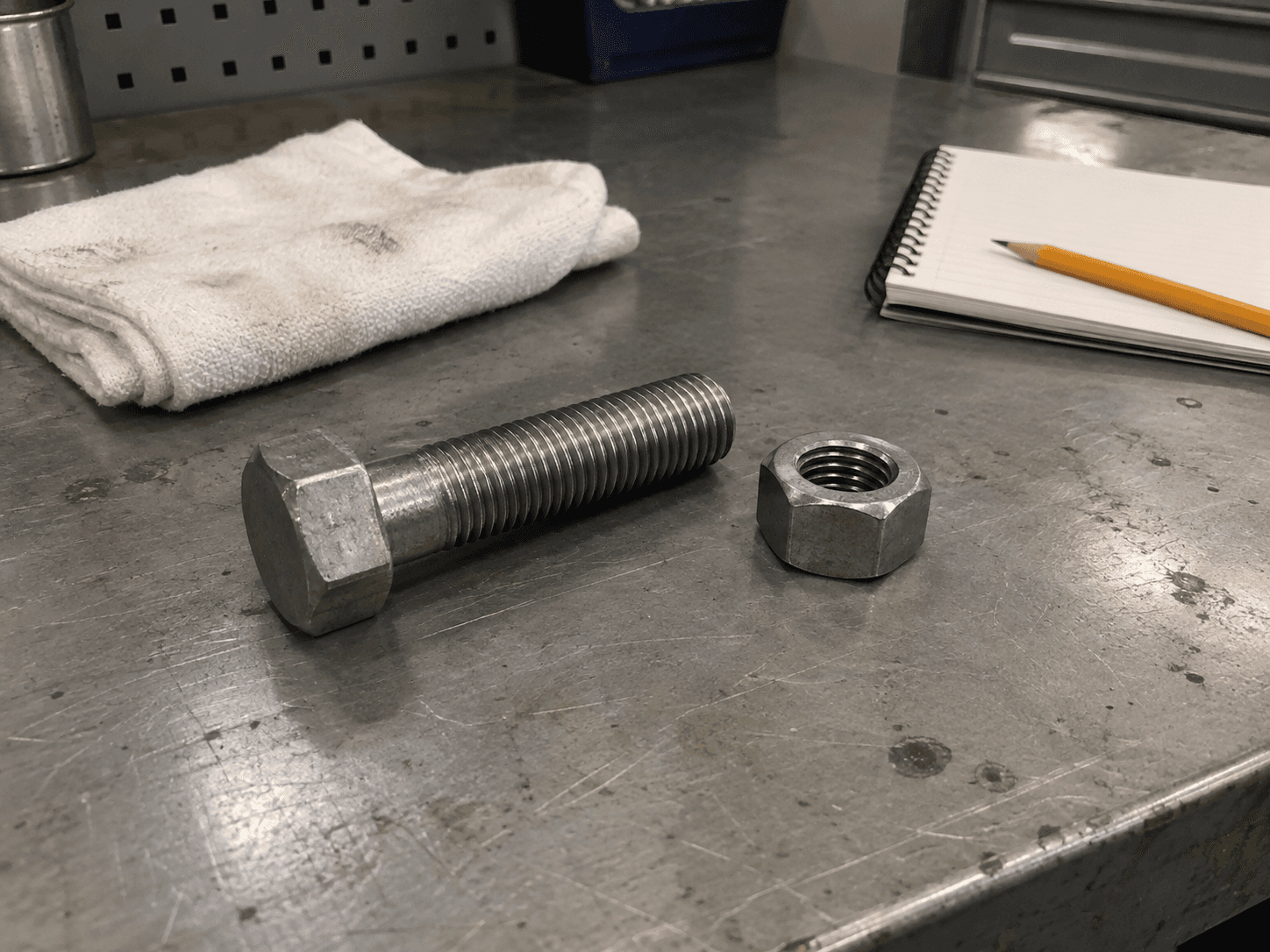
AI-generated conceptual illustration of a generic bolt, nut and inspection-planning supplies. Not a Richwood product, customer part, facility or measured finishing test.
First, identify the job and the feature
Tell the process supplier the material, thread size and pitch, whether the thread is internal or external, and the drawing's fit requirement. Pitch describes the spacing between threads. Include the thread class or other acceptance requirement exactly as specified rather than reducing it to “the screw goes in.”
Then identify the burr. Is it at the thread entrance, at the last thread, on a crest, or at an intersecting hole? A close-up and a marked drawing are more useful than the instruction “deburr all over.” Also identify surfaces and edges that are already acceptable.
For a part that needs an outside finish but has finished threads, the question is not simply which media cuts fastest. It is whether the complete process can achieve the outside requirement while preserving the thread requirement.
Separate thread deburring from protecting good threads
| Situation | Question to settle before a production batch |
|---|---|
| Threads already meet requirements; outside surfaces need finishing | Can the proposed cycle leave the threads acceptable after cleaning? |
| Burrs are on the threads themselves | Can the process reach and remove the burr, rather than leave or displace it? |
| A thread entrance or thin feature is vulnerable | Should localized deburring or a different operation sequence be evaluated? |
| Someone proposes a plug, cap or other protection | Is it compatible with the equipment and process, and does the trial prove it stays effective? |
| A part looks better but fails its thread check | Stop and investigate; appearance does not override the acceptance requirement. |
Targeted thread deburring may be more appropriate than treating the entire part. Conversely, a localized thread operation may still leave a useful role for mass finishing elsewhere on the component. Compare the complete route rather than expecting one operation to do every job.
Do not assume a protective plug is a ready-made solution. Agree any protection with the equipment and process supplier, and validate it on the actual part. Adding protection also adds installation, removal and inspection work; include that work when comparing routes.
Check the same requirements before and after the trial
Start with representative unfinished parts and a clear definition of an acceptable finished part. Keep the incoming condition documented so an existing defect is not mistaken for finishing damage.
Use the drawing and the applicable inspection plan to define the thread checks. Where specified, use the appropriate calibrated GO/NO-GO thread gauges and their prescribed method. A mating bolt or nut can help demonstrate an assembly concern, but it is not a substitute for required inspection.
Record three checkpoints:
- Before finishing: document the burr locations, incoming thread acceptance and critical outside features.
- After finishing and cleaning: check those same features, confirm burr removal, and inspect for retained media or debris using the agreed method.
- After any permitted rework: record the extra operation and repeat the required acceptance checks. Do not silently count a chased or reworked thread as a first-pass success.
For a failed thread check, investigate the actual condition before changing cycle time. Residue, a remaining or displaced burr, and a changed feature are not the same problem. A longer abrasive cycle is not a diagnosis.
Judge the route by accepted parts, not shiny parts
Include loading, protection if used, separation, cleaning, inspection and authorized rework in the comparison. A batch is not finished just because the tumbler has stopped.
The useful outcome is a repeatable route that meets both the surface requirement and the thread requirement. If the trial cannot demonstrate both, revise the route before committing production parts.
For the broader edge-preservation question, see deburring without over-rounding critical edges.
Have a threaded part to evaluate? Contact Richwood with the material, thread callout, burr location, batch quantity and acceptance requirements. Include a representative unfinished part and an accepted reference if available; confirm sample arrangements before shipping.