
If wet mass finishing suddenly produces excessive foam, check what changed in the water, compound delivery, media and incoming parts before adding defoamer. Foam alone does not identify the cause. The right correction depends on the machine and water system, and it still has to produce acceptable parts.
Start with two questions: Where does the foam first appear, and what is different from the last good batch?
Foam in a vibratory bowl, foam at a separation screen and foam in a recycling tank are observations worth recording separately. They are not, by themselves, three confirmed diagnoses.
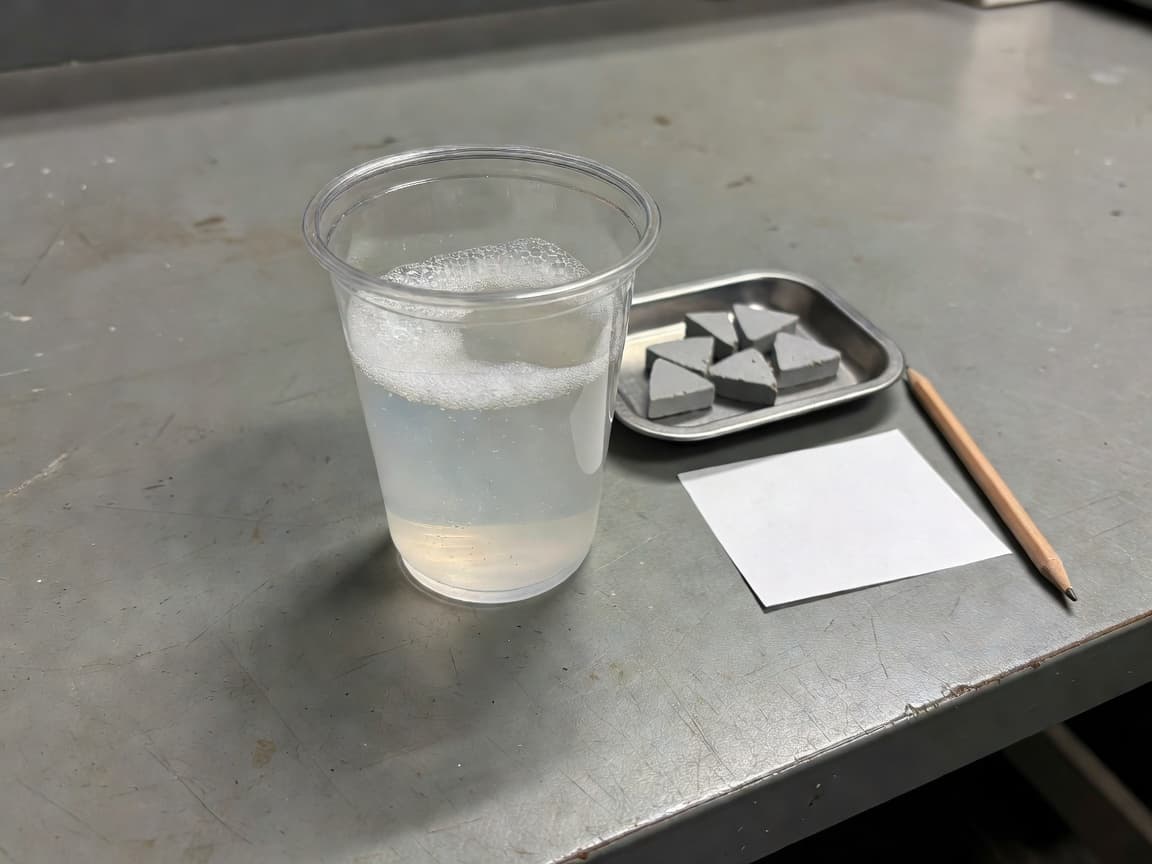
AI-generated conceptual illustration of a cup with bubbles beside generic media. Not a Richwood product photo, process-water sample, diagnostic test or finishing result. Appearance alone cannot establish water chemistry.
Why excessive foam matters
In some mass-finishing processes, excessive foam can interfere with contact between the parts and media, reducing the grinding effect. It can also complicate separation and carry contamination onto finished parts or surrounding equipment.
That does not mean every visible bubble is a problem. Look at the change from the established process and the effect on the job: burr removal, finish, cleanliness, separation and handling. A foam-free batch is not automatically a successful batch either.
Check these four things before changing chemistry
| Check | What to establish | Why it matters |
|---|---|---|
| Water | Has the source, treatment or reuse arrangement changed? Check hardness using the method your process supplier recommends. | Soft water can contribute to excessive foaming, particularly in some plastic-media processes. A photo cannot measure hardness. |
| Compound delivery | Confirm the exact product and compare actual delivery with the established setup. On a dosing system, check calibration rather than relying only on the dial. | The intended setting and the amount actually delivered are not the same evidence. |
| Media | Confirm the material, grade, size and any recent change or addition. | Media is part of the foam investigation, not just the cutting specification. A different formulation may behave differently. |
| Incoming parts | Check for a change in material, oil, cleaner carryover or other contamination. | A changed incoming load can require a review of the compound and water conditions. It does not prove that more compound is the answer. |
Keep the checks appropriate to the equipment. A flow-through bowl has incoming and outgoing fluid. A recycling system returns treated process fluid. A closed barrel uses its specified batch charge. Do not copy a water-flow instruction from one arrangement into another.
For the broader product-selection question, see how to choose a mass-finishing compound. If the problem appears in a return loop, also review the separate requirements for reusing process water.
Should you add defoamer?
A compatible defoamer can be part of the solution. It is not a universal first step, and this article cannot supply a dose for an unidentified compound and machine.
Ask the equipment or chemistry supplier whether the proposed additive fits the existing compound, part material, media, water loop and downstream operation. Use the current product instructions. Do not choose by a generic chemical name or assume that an additive suitable for one process fits another.
If repeated additions are needed, revisit the cause. Water conditions, the compound formulation or the media may need attention. Simply extending the cycle does not establish that the foam problem has been corrected.
Judge the correction by the parts, not just the bubbles
Compare an authorized change against the same acceptance checks used for the established process. Did the parts meet the burr, edge, surface and cleanliness requirements? Did separation and downstream handling remain acceptable?
Record the change and the result. When practical, change one factor at a time so the comparison remains useful. Keep the approved setup separate from the troubleshooting observations; the finishing-process record checklist provides a starting point.
What should you send with a foam-related inquiry?
Contact Richwood with the machine type and size, part material, media code, compound label and how water is supplied or reused. Include when the foam first appeared, what changed, and which part or handling requirement is now failing.
A photo can show where the foam occurs. The setup details and an accepted-finish reference make that photo useful for a process discussion.