Choose a mass-finishing compound by the part material, the media, and the job you need it to do: clean, support cutting, burnish, or help control corrosion. Then confirm that it suits your machine, water system, and downstream operation. A familiar product name or similar-looking liquid is not enough to establish a replacement.
Start with two questions: What is the part coming in with, and what must it look like when it leaves?
Oil on an incoming part is a different problem from residue after finishing. A bright surface is a different requirement from protection against rust. Some compounds serve more than one purpose, but that does not make them interchangeable.
What does finishing compound actually do?
In many wet mass-finishing processes, water and compound work alongside the media. The process fluid carries away material removed from the parts and media and helps keep the media surface active. Depending on the formulation, the compound can also support cleaning, lubrication, burnishing, or corrosion protection.
For your compound inquiry, identify the part material, the process, and the result you need. Tell Richwood whether the immediate problem is incoming contamination, cutting performance, appearance, or protection after processing.
That is why choosing the media is only part of choosing the process. The liquid in the machine is not just an incidental supply.
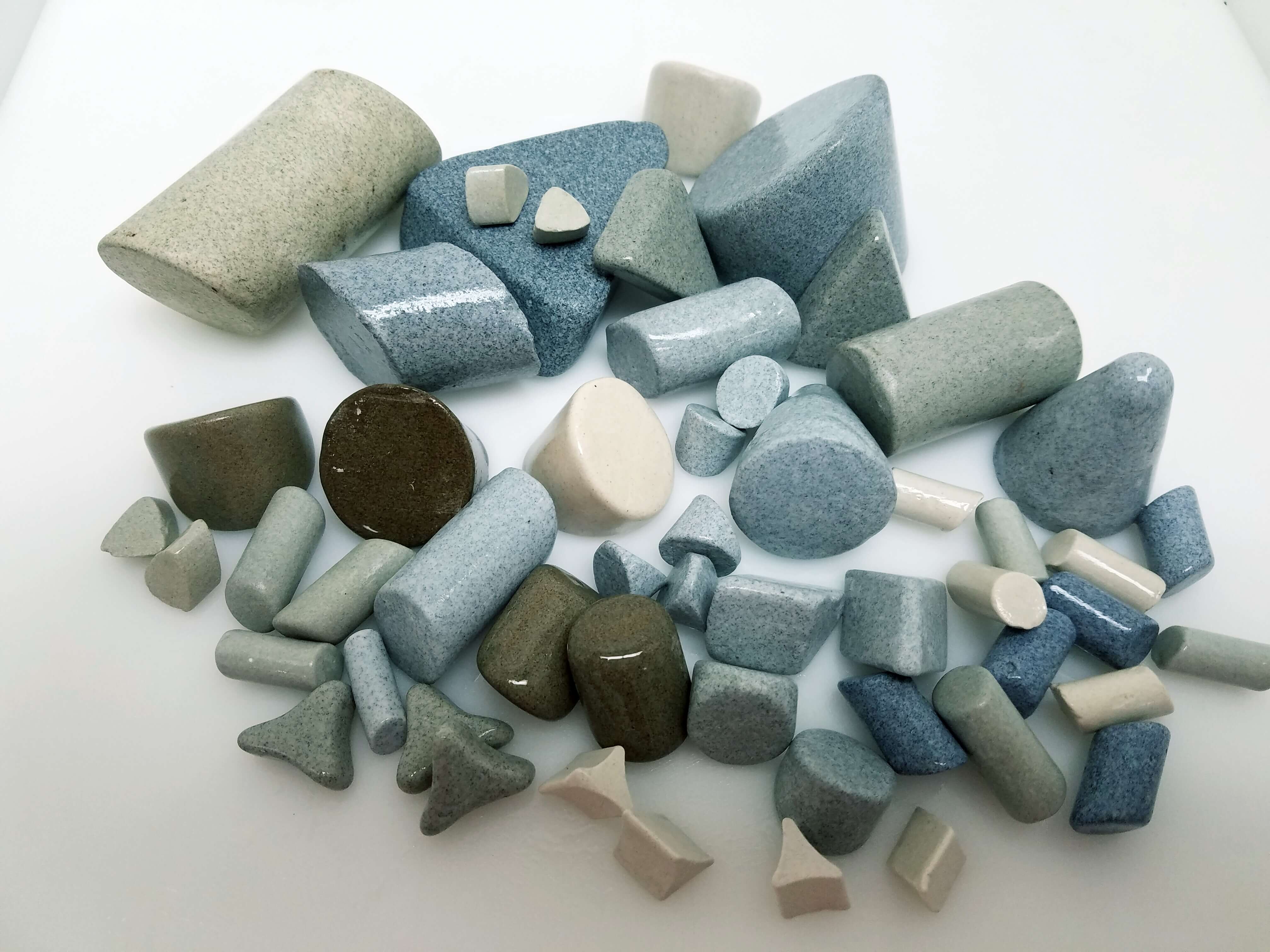
Real supplier photograph from Richwood’s approved media assets. Shown to identify the media side of the process; not a compound photograph, trial result, or before-and-after comparison.
Match the compound’s purpose to the problem
Use this as a conversation starter, not a dosing chart.
| What you need | What to establish before selecting a compound |
|---|---|
| Remove incoming oil or grease | Identify the metal, the contamination, and the media. A cleaner must fit all three. |
| Support cutting or surface refinement | Confirm the abrasive media and whether an abrasive compound is appropriate for the target finish. |
| Burnish or brighten a clean surface | Confirm the alloy, media type, and required appearance. Burnishing is not a substitute for removing every burr. |
| Address residue after finishing | Identify the media and the residue, then review the compound, water handling, and rinse step together. |
| Help protect ferrous parts or steel media | Establish when protection is needed: during processing, after rinsing, or during storage. Ferrous means iron-based. |
Richwood’s catalog shows why these distinctions matter. VF-100 Heavy Duty Cleaner is described for heavier oil and grease removal in ceramic-media processes, mainly with ferrous parts. In the compound catalog, VF-77T addresses white residue associated with plastic and synthetic media, while VF-RI-8B is listed for corrosion-protection uses such as dipping, spraying, or protecting steel media in storage.
Those are examples of different jobs, not recommendations for your load. Confirm the exact application before substituting one for another.
Powder or liquid is not the first decision
The physical form does not tell you the whole function. Richwood lists both powdered and liquid products with different purposes. Compare the stated application and preparation instructions for the exact product, rather than choosing by form alone.
First establish what the chemistry needs to accomplish. Then check how the product should be prepared and delivered in your equipment. A product used in a flow-through system, where fresh solution enters and exits, should not automatically be treated as a recipe for a closed barrel.
Follow the current product instructions and safety data sheet. Confirm compatibility with the part, media, and machine before changing the process. There is no single concentration that this article can responsibly recommend for every compound and machine.
Before you change products, capture the current setup
Give the person helping you enough detail to compare the existing process with the proposed change:
- Part material and any condition that must not change, such as a critical edge or surface.
- Machine type and size, plus whether the process uses a closed batch, flow-through water, or recirculation.
- Media material, shape, size, and current condition.
- Exact compound name or code, how it is measured, and how water is added.
- Incoming oil or other contamination, the problem observed, and when it first appears.
- What happens after finishing: separation, rinse, drying, storage, coating, or assembly.
Keep the existing settings with the record. If you change the media, compound, water delivery, and cycle together, it becomes harder to identify which change helped.
What counts as a successful change?
Agree on the acceptance checks before evaluating a different compound. Depending on the part, that may include cleanliness, appearance, burr removal, critical dimensions, or condition after a defined storage interval. A brighter part is not automatically an acceptable part.
For a controlled comparison, document what changed and inspect against the same agreed requirements. Do not treat an attractive sample photograph as proof of cleanliness, corrosion resistance, or dimensional compliance.
Need the compound match checked? Start with the Richwood finishing-compound catalog. Add the closest product to your quote request and include the current label or code, part material, media, machine, and finish problem. That gives Kevin a useful starting point instead of asking him to guess from the color of the liquid.