
If steel parts rust after wet mass finishing, first identify where rust starts: in the machine, after the rinse, during drying, or while parts wait for the next operation. The correction may involve the finishing compound, rinse, drying handoff or temporary corrosion protection. Simply adding more compound or running the finishing cycle longer does not establish the cause.
Flash rust is corrosion that develops quickly on a freshly exposed iron or steel surface in the presence of moisture. This guide concerns rust-prone ferrous parts, such as carbon steel and cast iron. Orange marks on stainless steel or an unfamiliar alloy need a separate material and contamination investigation, not an assumed carbon-steel remedy.
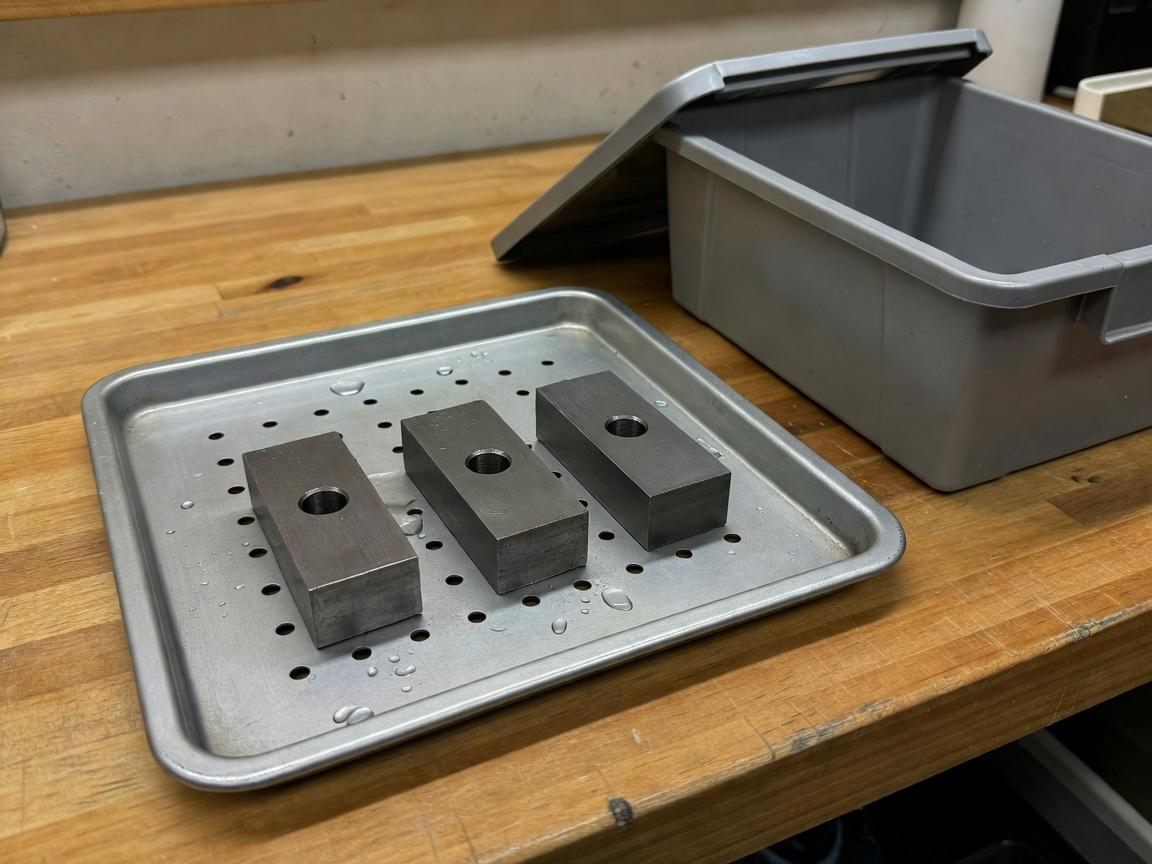
AI-generated conceptual illustration: generic machined blocks on a draining tray beside a storage tote. Not a Richwood product, customer part, facility or measured corrosion test.
Start with the last rust-free checkpoint
What is the material? When did you last see the part without the stain? What happened between that point and inspection?
Record the time and condition at machine discharge, after rinsing, after drying, and before the next operation. Use the same lighting and inspect recesses as well as easy-to-see faces. A stain is a clue; have quality confirm whether it is corrosion, residue or transferred contamination before changing the process.
| First observed problem | What to check next | What not to assume |
|---|---|---|
| Rust already visible at discharge | Material identification, compound suitability, concentration checks and working solution condition | Every finishing compound provides the same corrosion protection |
| Parts look clean at discharge but rust after rinsing | Rinse stages, water condition and whether the intended protective treatment survives that sequence | A clean-water rinse necessarily leaves the part protected |
| Rust appears while wet parts wait or dry | Queue time, retained water, drainage and the qualified drying method | A dry outside face proves that holes and recesses are dry |
| Parts pass immediate inspection but rust before use | Actual hold time, handling, storage conditions and protection requirements | Protection during finishing guarantees protection through storage or shipping |
These are investigation paths, not diagnoses from appearance alone.
Separate in-process protection from the storage requirement
A compound can have a corrosion-inhibiting role during finishing without meeting every later storage requirement. Suppliers distinguish between corrosion control in the machine and a separate post-process treatment. The right choice depends on the metal, process sequence and required protection window.
Give the supplier the complete sequence, including any plain-water rinse after an inhibited stage. Ask where the protective treatment belongs and whether subsequent rinsing removes or weakens it. Follow the selected product's technical instructions and approved concentration-check method; do not transfer a mixing ratio from another product or application.
Avoid changing several chemicals at once. First document the current working solution and compare it with the established process. A controlled change is easier to evaluate than an unrecorded top-up.
Qualify the wait, not just the machine cycle
A trial that goes straight from finishing to drying can miss a production queue. Include the realistic delay between separation, rinsing, drying and the next operation. Record the longest hold the process must tolerate, rather than borrowing a supplier's protection-time claim for different conditions.
For drying-method selection, see How Should You Dry Parts After Wet Mass Finishing?. Here, the question is whether the complete sequence keeps the part acceptable until it is used, not simply which dryer removes water.
Inspect representative trial parts immediately and again at the required hold point. Agree on the inspection method and acceptance criteria with quality. If storage or shipment is part of the requirement, include the proposed handling and packaging in the evaluation; passing an immediate check does not qualify that later exposure.
Keep the next operation in the decision
Temporary protection is useful only if the next process can accept it. Tell the supplier whether the part goes to coating, plating, bonding, assembly or storage, and identify any residue restrictions. Confirm compatibility with the downstream processor instead of assuming a rust inhibitor is universally coating-ready or residue-free.
If parts already show rust, keep that lot separate for disposition. Removing the visible mark is not proof that the surface or critical dimensions still meet the drawing.
What to send Richwood
Start with the material grade, photographs showing where the problem appears, machine and media details, compound identification, and the actual rinse-to-dry-to-storage sequence. Include the time when rust first becomes visible and what the next operation requires.
Talk with Richwood about your finishing process. A useful starting question is simple: where is the part last acceptable, and what must stay acceptable until the next step?