Not always. Some wet mass-finishing processes can clean and deburr in the same cycle. A separate prewash is needed when the proposed finishing process cannot reliably handle the incoming contamination while meeting the part's finish and cleanliness requirements. Decide from the oil, alloy, equipment and acceptance criteria—not from how clean one sample looks.
Start with a practical question: what is on the part when it reaches the finishing machine? A light film of a known machining coolant is a different starting condition from a variable load of heavy oil, grease and loose chips. Tell your process supplier what actually arrives from production before choosing the compound or eliminating a wash step.
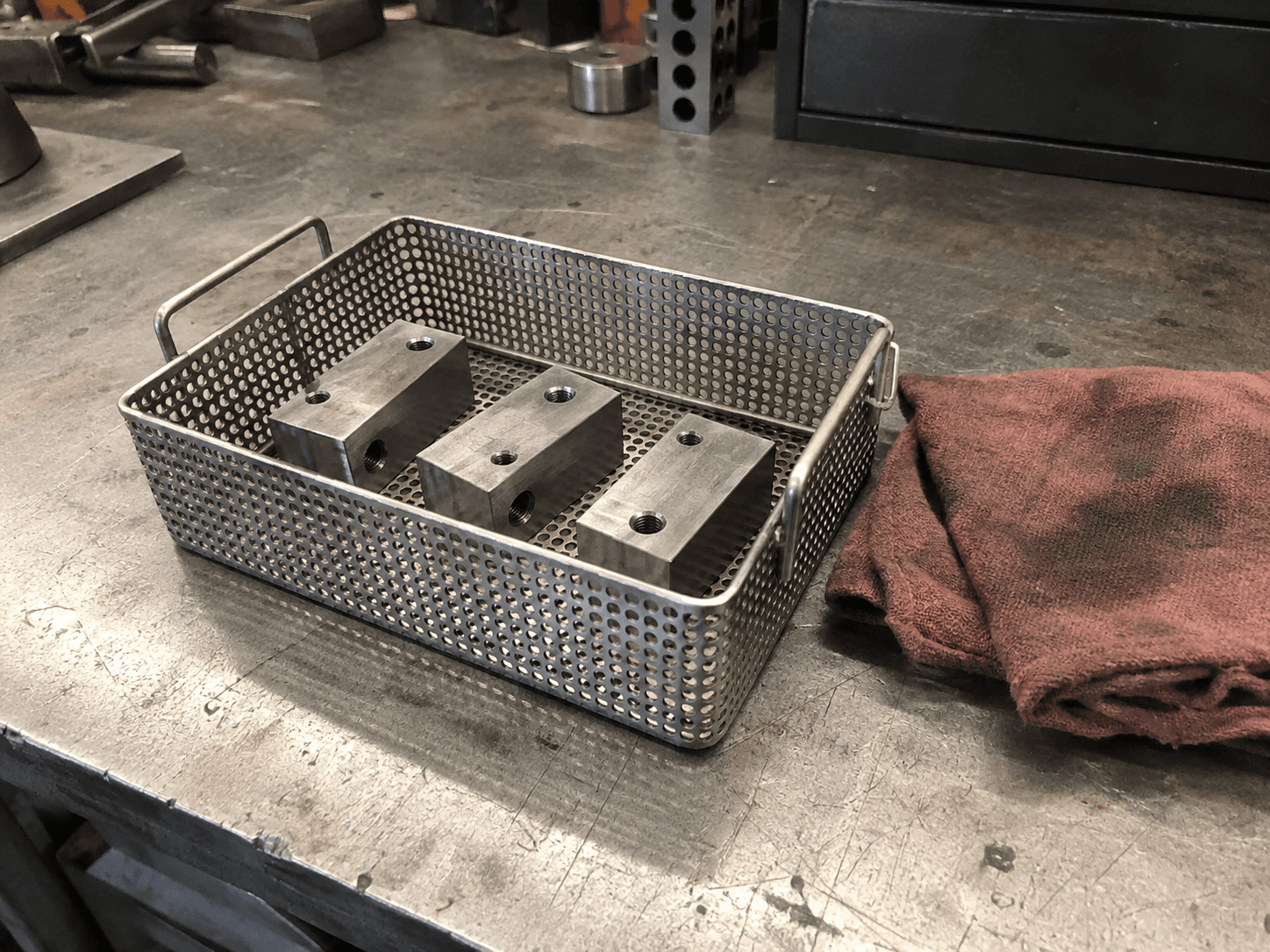
AI-generated conceptual illustration: generic machined blocks in a parts basket beside a shop cloth. Not a Richwood product, facility, customer part or measured cleaning test.
Cleaning and deburring are different jobs
Deburring removes unwanted material at an edge. Degreasing removes oil or grease from the surface. A suitable combination of equipment, media, water and compound may do both, either together or as separate stages. That is a process option, not a promise that any tumbler and any compound will clean any oily part.
A compound is the process chemical used with the finishing system. Its suitability depends on the metal and the job. A cleaner suitable for ferrous metals—iron-based materials such as steel—is not automatically suitable for aluminum or another alloy. Use the supplier's technical instructions and safety data sheet for the actual product; do not transfer a concentration from an unrelated process.
Decide whether to trial a prewash
| Incoming condition | Decision to discuss with your process supplier | What the trial needs to establish |
|---|---|---|
| Known, reasonably consistent oil or coolant film | Evaluate a combined cleaning-and-finishing cycle | Both the specified finish and cleanliness are achieved |
| Heavy or changing oil load | Compare a controlled prewash with the combined route | The process still works across the expected incoming conditions |
| Loose chips or residue in recesses | Define an upstream removal step and an inspection method | Contamination is removed from the relevant features, not just visible faces |
| Sensitive alloy or critical surface | Confirm chemical and mechanical compatibility first | No unacceptable surface change, dimensional change or staining |
| Tight cleanliness requirement after finishing | Define the final cleaning, rinsing and verification sequence | The finished part meets the actual downstream acceptance requirement |
The table is a trial-planning guide, not a universal operating recipe. A prewash does not replace final cleaning when the next operation requires it. Likewise, a combined cycle should not be rejected simply because cleaning and deburring have traditionally been separate operations.
Test the incoming condition you will actually run
Do not send only hand-wiped parts if the production batch will arrive oily. Describe the normal condition and the expected variation. Identify the alloy, lubricant or coolant, how long parts sit before processing, the relevant holes or recesses, and what the next operation requires.
Agree on the acceptance method before the trial. Burr removal, edge condition and surface appearance are not substitutes for a cleanliness requirement. If cleanliness matters to assembly or another operation, have the responsible quality team specify how it will be evaluated. A photograph cannot establish residue-free cleanliness.
Where both routes are plausible, compare representative parts through a prewash-plus-finishing route and a combined route. Keep a record of what changed. Include the rinse, drying, handling and inspection steps in the comparison, not only time inside the finishing machine.
Look beyond the first successful batch
The useful production question is whether the result can be repeated as the incoming contamination changes and the process water is used. Ask how the proposed system manages oil and other contamination, when the bath or water needs attention, and what operators should check before the next batch. Those controls belong in the process definition, not in an operator's guesswork.
A combined cycle may remove a handling step. A prewash may make the incoming condition more consistent. Neither route is automatically cheaper. Compare labor, chemistry, water management, handling and accepted parts before deciding which step to keep or remove.
What to send Richwood
Start with the part and the required result. Share the alloy, a description of the oil or coolant, the incoming condition, batch volume, existing machine and the finish or cleanliness requirement. Ask what representative samples and finished reference are appropriate before shipping anything.
Contact Richwood about your finishing process. The next step is to agree on what needs to be demonstrated—not to assume that a different compound alone will solve the problem.