
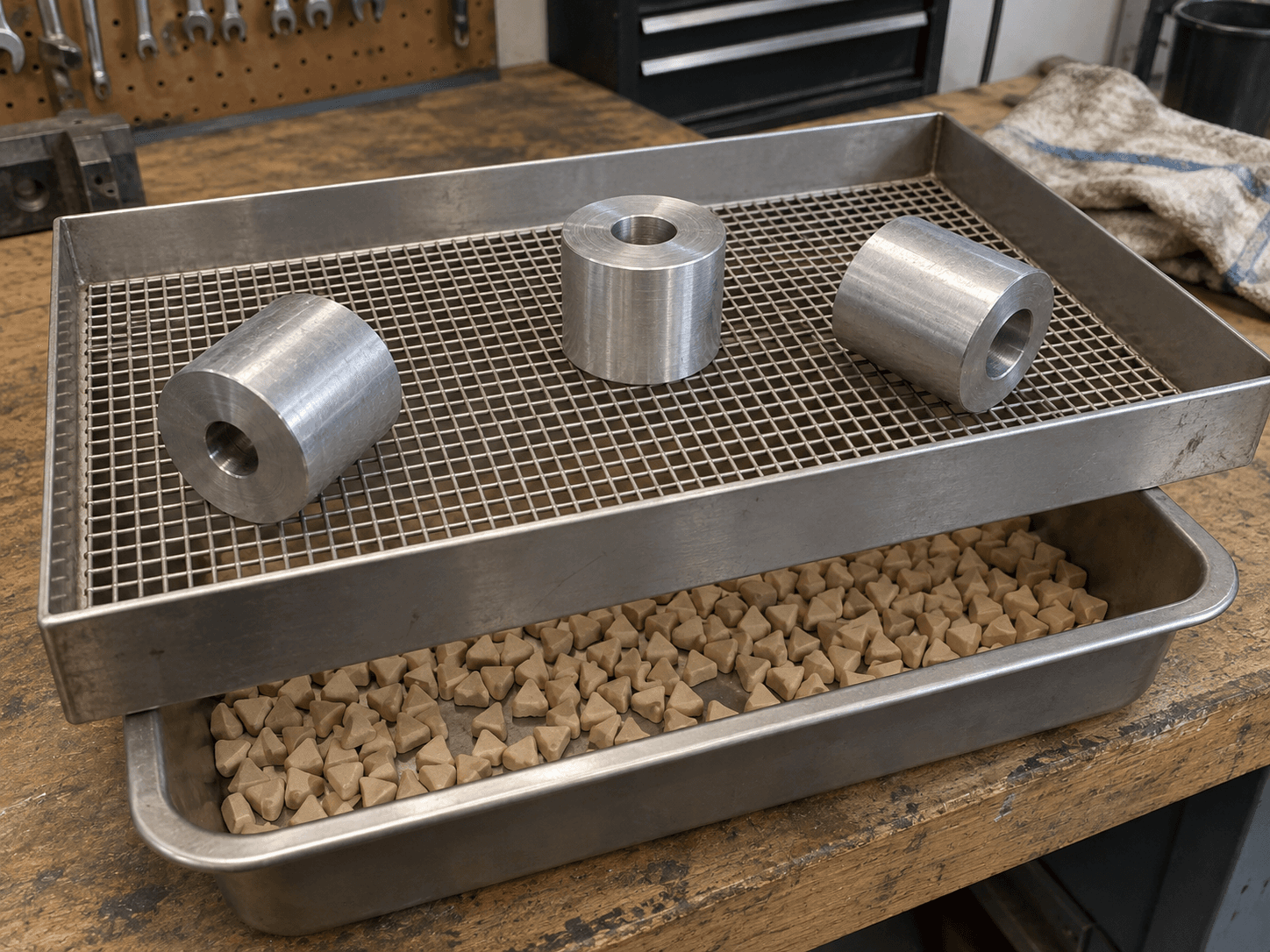
Choose the separation method with the part and media together. A screen is a candidate when their sizes and shapes let one pass through while retaining the other. When parts and media are too similar in size, a different separation approach may be needed. Magnetic separation is an option for suitable magnetically responsive parts, not a universal solution for metal parts. Prove the separation step with the actual load before committing to the process.
Start with three questions: What must stay above the screen? What must pass through? Where will each go afterward?
Separate two different problems
Loose media mixed with finished parts is a separation problem. Media trapped inside a hole or recess is a lodging problem. A screen that sorts the loose load does not establish that every part is free of trapped media.
If someone is picking media out of features, start with the media-lodging checklist. Here, the question is how to route the loose parts and media into their intended destinations without adding an unplanned sorting job.
Check whether screening fits the load
Walther Trowal describes integrated screening sections in many circular and continuous finishing systems, and separate screening machines for equipment without an integrated screen. The manufacturer's guidance also identifies small parts and parts close to media size as cases requiring application-specific separation.
Do not choose a screen from the bag label alone. Bring the proposed screen, representative parts, and the media actually in use into the evaluation.
| Check | Question to answer before approval |
|---|---|
| Part geometry | Can a thin feature or a differently oriented part enter the opening? |
| Media geometry | Will the intended media pass or be retained as required, including different orientations? |
| Working media condition | Does the separation still work with representative worn media, not just new pieces? |
| Both discharge paths | Do parts reach the part container and media reach the media container? Inspect both. |
| Transfer and collection | Are surfaces still acceptable after the screen, discharge, and collection steps? |
| Batch changeover | Can the equipment be emptied and checked before the next job? |
This is a trial checklist, not a screen-aperture formula. There is no universal opening size recommended here. The actual part, media, equipment, and acceptance requirements decide the result.
What if the parts and media are nearly the same size?
Do not assume a finer screen will solve it. First establish whether a useful size-based separation is available at all.
Walther Trowal identifies magnetic separators for ferritic parts similar in size to the abrasive media. Ferritic here refers to a class of iron-based material that responds to a magnet; do not treat every metal or every stainless-steel grade as equivalent. Ask the equipment supplier to confirm compatibility with the actual part and media combination.
If screening is unsuitable and magnetic separation does not fit, revisit the process with the supplier. A different media choice or handling arrangement must still deliver the required finish and protect the part. Easier sorting is not a reason to accept an unsuitable finishing process.
These are general process options, not a claim that Richwood stocks or supplies every separator described.
Make the trial end at the collection container
A useful separation trial should answer more than whether the load went across the screen.
Record the part identification, material, batch quantity, media code and condition, equipment, screen identification, and intended routing. Then record:
- Parts found in the media stream and media found in the part stream.
- Any retained parts or media inside the equipment after unloading.
- Media lodged in features, checked separately from loose-media carryover.
- New marks or other acceptance failures after transfer and collection.
- Hands-on sorting time, unloading time, and changeover work.
Set the acceptance limits before the trial according to the drawing, quality plan, and next operation. Do not turn a visually clean sample into a guarantee about production batches. Observe normal operation and follow the equipment's operating and isolation instructions during checks.
Walther Trowal specifically treats separation as part of sample processing and emphasizes avoiding media carryover and mixing different batches. That is the useful buying lesson: include the separator and collection steps in the process you evaluate.
For timing the whole operation, use the batch-time worksheet. Keep this narrower decision separate: can the proposed method sort this actual load to the agreed requirements?
Bring the part and media details, not just a screen size
Talk with Richwood about your finishing process. Include the part material and dimensions, current media code, machine type, batch quantity, and what is ending up in the wrong container. A clear photo of the part beside representative media helps Kevin start with the right questions.
Technical source
Walther Trowal: Separation in mass finishing, accessed September 26, 2026. Undated manufacturer guidance on screening, magnetic separation, batch separation, and trial integration; not a new product announcement or Richwood test result.