
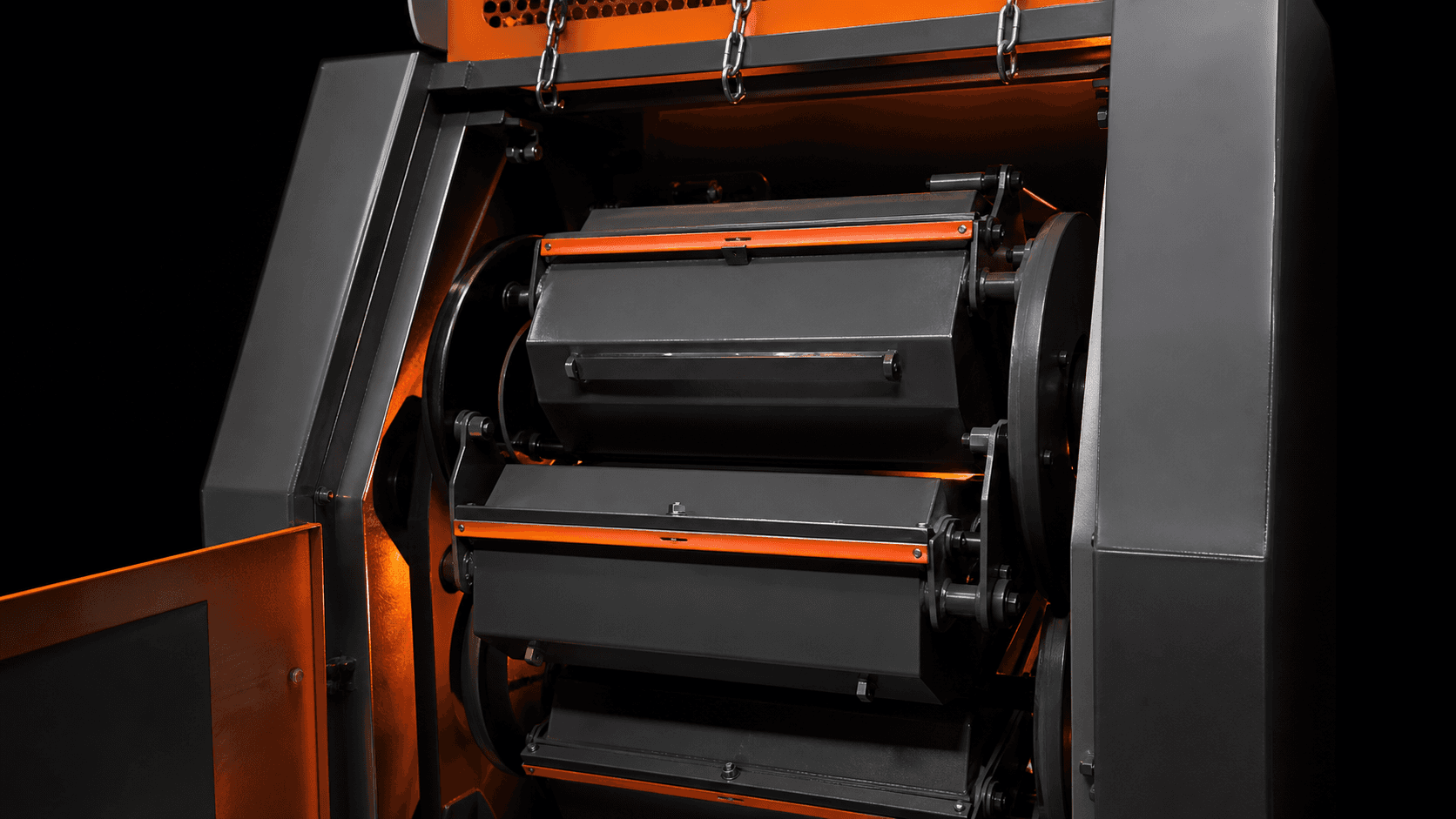
A centrifugal barrel finishing cycle usually takes 15 to 45 minutes for deburring, about 30 to 60 minutes for edge radiusing or heavier stock removal, and one to three hours for a polish or mirror finish run in stages. The same jobs take a vibratory bowl 4 to 24 hours. The difference is force: up to roughly 25 G in a centrifugal barrel against about 1 G in a bowl.
Those are working ranges from real parts, not a promise. The only way to know your cycle is to run your part, which is why we test parts for free before anyone buys a machine.
Typical cycle times by job
| Job | Centrifugal barrel | Vibratory bowl |
|---|---|---|
| Light deburring, small burrs | 15 to 30 minutes | 4 to 8 hours |
| Heavy deburring, edge break | 30 to 45 minutes | 6 to 12 hours |
| Edge radiusing, stock removal | 30 to 60 minutes | 8 to 16 hours |
| Smoothing before plating or coating | 45 to 90 minutes | 8 to 24 hours |
| Polish or mirror, multi-stage | 1 to 3 hours total | 12 to 24 hours or more |
A batch that takes a vibratory machine 4 to 8 hours often finishes in about 30 minutes in a centrifugal barrel. That is the number most shops care about, because it means one machine replaces an overnight run.
What sets the time
Five things decide how long your part needs in the barrel:
- Material. Titanium, hardened steel, and Inconel cut slowly. Aluminum, brass, and mild steel cut fast.
- Burr size. A burr left by a sharp tool at a clean edge goes in minutes. A rolled burr from a worn tool takes longer than any finishing change can save. Fix the tool first.
- Finish target. Removing a burr is one thing. Hitting a specific surface roughness or a mirror is a second and third stage with finer media.
- Media. Ceramic cuts. Plastic cuts gently and protects soft metals. Porcelain and steel burnish rather than cut. Bigger media moves more material per pass, as long as it still reaches the feature. Our media selection guide walks through it.
- Load. A barrel filled to the right level with the right part-to-media ratio runs fast and protects parts. Overload it and the bed stops sliding, the cycle stretches, and parts start touching. The compartment dividers on the RW-120 and RW-220 exist for this reason.
Why the force matters
Picture a Ferris wheel. The turret is the wheel and the barrels hang off the rim. As the turret spins one way and the barrels counter-rotate, the contents are pressed outward into a packed, sliding bed that grinds against itself. That bed does the work. At up to roughly 25 G, every minute in the barrel does the work of many minutes in a bowl. The full explanation is on our how it works page.
How to shorten a cycle
- Fix the burr at the tool before you fix it in the barrel.
- Run the largest media that still reaches every feature.
- Keep the barrel at its design fill level and let the dividers separate parts.
- Split heavy cutting and final polish into two short stages rather than one long one.
- Use fresh compound. Worn compound lets the media load up and cut slower.
Batch, not continuous
Centrifugal barrel finishing is a batch process. You load, run, unload, and separate. Throughput comes from short cycles and running four barrels at once. An RW-220 with four 55 liter barrels running back to back through a shift will finish more parts than a vibratory bowl that has to run all night, and it will do it with the same result every batch.
Find your number
Send us the part. We run it in the machine you would buy, write down the media, compound, and cycle time, and send the part back so you can hold the result. That takes days, not the 90 days a build-to-order quote takes. Start a sample test or compare the machines on the machines page.
Common questions
How long does a centrifugal barrel finishing cycle take?
Deburring usually runs 15 to 45 minutes. Edge radiusing and heavier stock removal take 30 to 60 minutes. A polish or mirror finish is a multi-stage process of one to three hours. Vibratory finishing takes 4 to 24 hours for the same work.
Why is it faster than vibratory finishing?
Force. A centrifugal barrel presses media against parts at up to roughly 25 G. A vibratory bowl works at about 1 G. More force means more cutting per minute.
What makes a cycle longer?
Harder material, larger burrs, a finer finish target, smaller or softer media, and an overloaded barrel. Running the right fill level with the right media size is the fastest fix.
Can you run it continuously?
No. It is a batch process. Throughput comes from short cycles and four barrels running at once, not from continuous feed.