
Mass finishing does not, by itself, establish that stainless steel meets a passivation requirement. If the drawing or purchase specification calls for passivation, plan the mechanical finish, cleaning, treatment and required verification as one controlled sequence. If no treatment is specified, the responsible engineering or quality team should decide what is needed for the alloy and application. A bright part is not enough evidence either way.
Start with two questions: what must the finished part look and measure like, and what must it demonstrate about corrosion resistance? Those are different acceptance decisions.
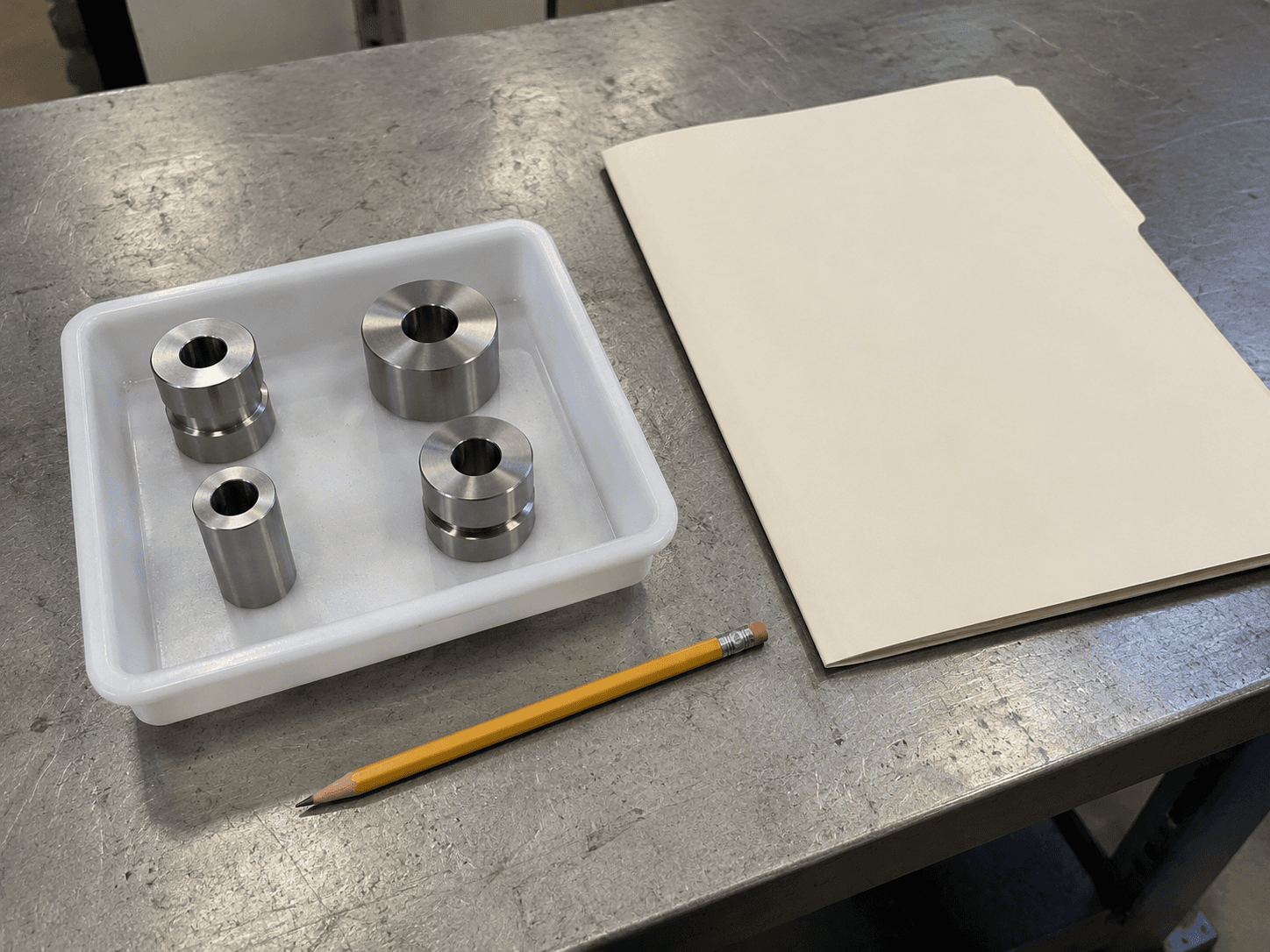
AI-generated conceptual illustration: generic metal spacers in a white tray beside a blank job folder on a workshop bench. Not Richwood products, customer parts or evidence of a passivation test.
Deburring and passivation solve different problems
Mass finishing uses the interaction of parts, media and the selected process to remove burrs or change surface condition. Your acceptance criteria may include edge condition, surface roughness and dimensions.
Passivation addresses a different concern: the surface condition that supports stainless steel's inherent corrosion resistance. Fabrication can leave iron contamination on a stainless surface. A suitable passivation treatment removes surface contaminants such as free iron; it is not a paint coating, and it is not a substitute for removing burrs.
Stainless steel can form a protective oxide film naturally when a clean surface is exposed to oxygen. That does not mean every fabricated part is clean, or that natural film formation satisfies a specified treatment and test requirement.
Nor should you assume that a finishing compound provides the required passivation simply because it cleans the part or helps control corrosion during finishing. Confirm the actual process and its acceptance evidence.
Agree on the handoff before the trial
For an engineering or quality buyer, the useful deliverable is a process route with clear responsibilities. Use this planning table before approving a batch:
| Decision | What to agree | Evidence to retain |
|---|---|---|
| Material and requirement | Exact stainless grade, drawing revision, applicable treatment specification and customer requirements | Material identification and the controlling documents |
| Mechanical finish | Burr locations, edge limits, critical dimensions and surface-finish target | Inspection results against those requirements, not just a photograph |
| Cleaning and treatment | What removes finishing residues; who performs any required passivation; where it sits in the route | Approved process instructions and the treatment provider's agreed records |
| Acceptance testing | Applicable test, sampling, acceptance criteria and who releases the lot | Results tied to the lot and required documentation |
| Handling after treatment | Containers, tools, packaging and any later operation that touches the surface | Defined handling route and review of downstream operations |
This is a handoff checklist, not a chemical recipe. Do not choose acid concentration, temperature or treatment time from a general blog article. The alloy, controlling specification and qualified process determine those details.
Put the operations in the right order
A sensible route to evaluate is mechanical finishing, appropriate cleaning, specified passivation, rinsing and drying, then the required verification and controlled handling. The approved route may need additional steps; agree it with the treatment provider and quality team.
Cleaning before passivation matters. Oils, shop debris and finishing residues must not be treated as though the passivation bath will automatically remove them. Heat-treatment scale or weld-related oxides may require a separate removal process too; passivation is not a general descaling treatment.
If someone proposes more grinding, tumbling or other surface work after passivation, stop and review the route. Do not assume the earlier treatment still establishes the condition of the final surface.
Shared equipment creates another question. For the machine-history and contamination controls, see our stainless and carbon-steel changeover guide. That is a separate decision from selecting and verifying a passivation treatment.
What proves the result?
Use the acceptance criteria in the applicable requirement, not a visual shortcut. ASTM A967/A967M covers chemical passivation treatments and alternative qualitative tests for their effectiveness, particularly removal of contaminant iron and other foreign matter. It does not select the right grade, treatment or acceptance criteria for every application.
Do not turn a list of test options into an instruction to perform every test. Have the responsible quality team and treatment provider establish which requirements apply. Likewise, a passing treatment verification is not a promise that a part will resist every service environment.
A finished reference part is useful for communicating appearance. A photograph of it cannot replace dimensional inspection or the required passivation evidence.
What should you bring to a finishing discussion?
Bring the stainless grade, drawing and treatment requirements, unfinished parts or clear photographs, and a finished reference if available. Include the expected batch volume and the full route after deburring. Identify who owns the passivation and final-release decisions before changing the finishing process.
Contact Richwood to discuss the mechanical-finishing portion of your process. The starting point is the part and its acceptance requirements, not a promise that one tumbling cycle will satisfy every downstream requirement.